
by Joseph Murphy, Director of Strategic Partnerships
In our recent editorial on Freedom and Its Futures, our ongoing conversation series with Brooklyn Public Library, we traced the larger arc of the series. On February 11 at the Center for Brooklyn History, that arc narrowed to something closer to home. The question was simple: is freedom, as we tend to define it, enough?
Long before Adam Smith wrote The Wealth of Nations (1776), he was preoccupied with a quieter problem. In The Theory of Moral Sentiments (1759), he describes the “impartial spectator,” that internal observer through whom “we endeavour to examine our own conduct as we imagine any other fair and impartial spectator would examine it.” Before the invisible hand, there was this inward glance. We do not merely act; we watch ourselves acting. We supply explanations. We try to appear reasonable, even to our own minds.
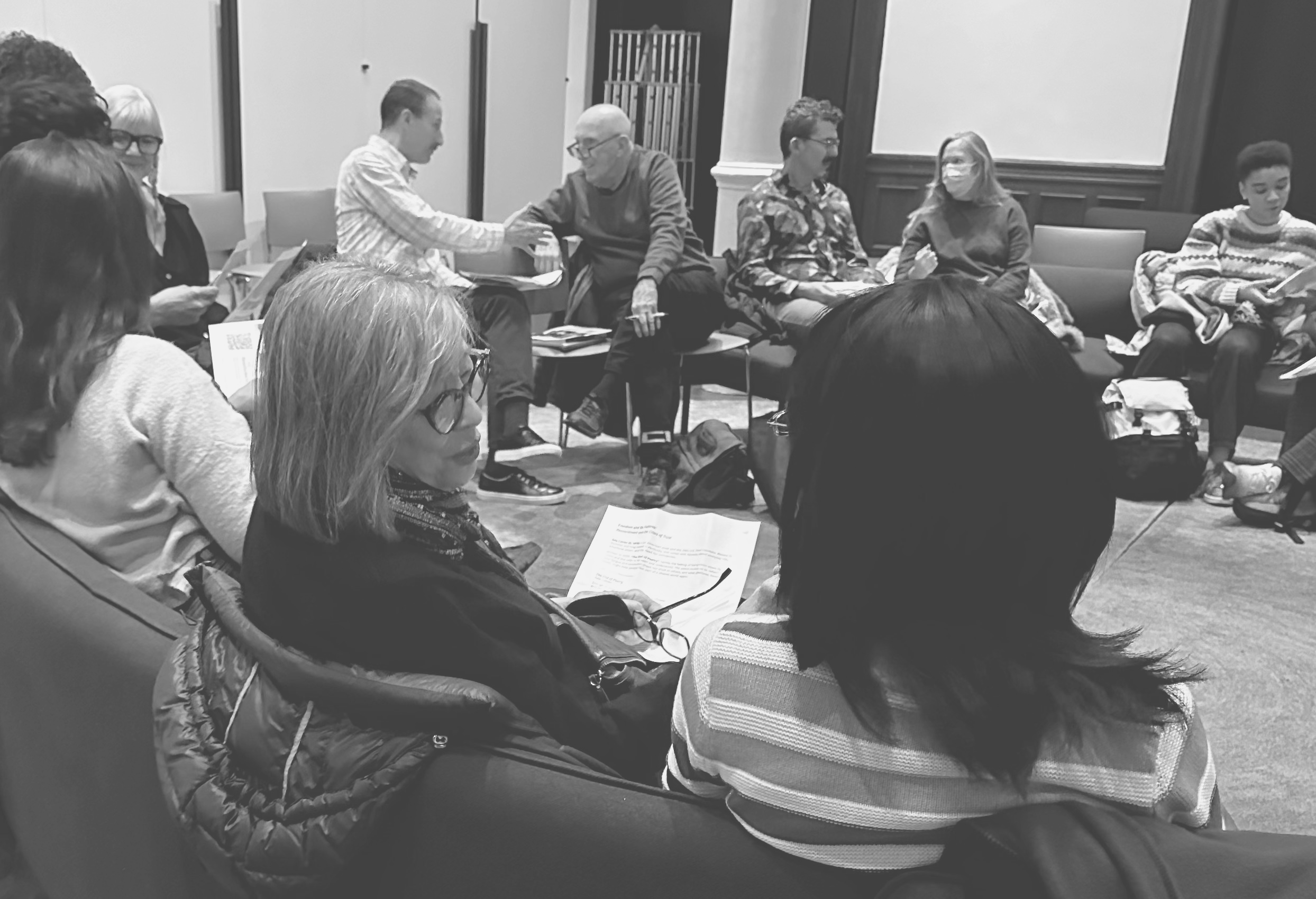
That inward scrutiny framed the latest Community Conversation, Market Thinking and the Erosion of the Common Good. Participants read Zadie Smith’s essay “Joy,” which turns on a simple but unsettling distinction: the difference between pleasure and joy. The shared surname felt suspiciously apt: Adam Smith asks how we judge ourselves; Zadie Smith asks what kinds of experience can withstand that judgment.


Why does delight sometimes come with an “apology?”
In her essay, pleasure is orderly. It can be scheduled, described, defended. It fits neatly into adult life. Joy is less cooperative. It arrives without regard for plans. It can feel excessive, even faintly embarrassing. Participants lingered over that contrast. Why do we defend certain satisfactions more easily than others? Why does delight sometimes come with an apology?
The conversation widened almost without noticing. Someone drew a line from pleasure and joy to the workplace and broader “hustle culture.” What counts as a good use of time? What feels sensible? It became clear that the traits that make pleasure respectable—its predictability, its manageability—also shape how many of us evaluate our days. Market thinking surfaced not as a manifesto but as a vocabulary. It gives us options. It also teaches us to prize what can be measured and displayed. Freedom opens in one direction and tightens in another.

During the discussion, someone drew a line from joy to the workplace and “hustle culture.”
Photograph by Roger Smith (1943)
By evening’s end, the original question had shifted. If freedom means choice, is choice sufficient? Other freedoms came into view: the freedom that comes from security, from recognition, from being heard without first proving one’s worth. Many of these depend on shared conditions no one creates alone. Trust. A functioning public space. The ordinary assurance of belonging. The common good entered quietly, less a slogan than a background necessity.
Freedom opens in one direction and tightens in another.
More than one participant remarked that the conversation itself had brought joy. One attendee, with cheerful emphasis, said, “I really didn’t know what to expect. But I really enJOYed this!” The room laughed, and the comment carried its own argument. Community Conversations are not lectures and not performances. They are rooms where people practice democracy in its most human form: reading with care, listening without haste, revising a thought in the presence of others.
As the country commemorates its 250th year, that practice feels newly relevant. When the break with Britain came in 1776, some contemporaries described the decision as “a leap in the dark.” The phrase was not rhetorical flourish. It named the uncertainty of the moment: a step taken without knowing how events would unfold. Democracy still requires such leaps, though they are usually quieter ones. A group gathers around a text. No one knows quite where the discussion will land. Adam Smith’s “impartial spectator” reminds us that we are always judging ourselves. But democratic life cannot rest on caution alone. The uncertainty in the room is not a flaw in the design. It is part of the experiment. And it remains, in its modest way, an act of freedom.